
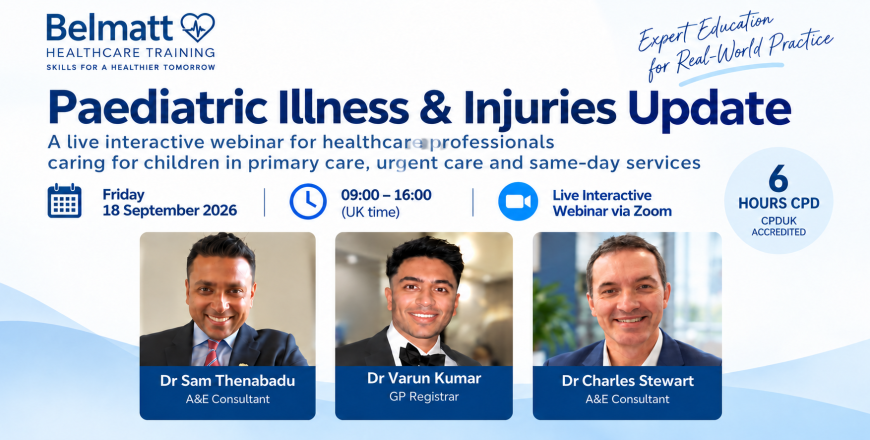
Paediatric Injuries and Illness Conference 18 September 2026

- Description
- Curriculum
Live Online Paediatric CPD Conference for Primary Care & Urgent Care Clinicians
This one day live webinar delivered via zoom is recommended for clinicians who assess and manage children and young people in primary care, urgent care and emergency settings. The conference will build confidence in spotting the sick child, recognising red flags and managing common presentations including fever, sepsis, respiratory illness, minor injuries, head injuries and concussion. Delegates will explore structured paediatric assessment, clinical decision-making, escalation and effective safety-netting through practical cases and discussion. The programme is particularly relevant to GPs, Advanced Clinical Practitioners, Nurse Practitioners, Paramedics, Pharmacists and other clinicians involved in assessing children and young people.
Date: Friday 18 September 2026 Time: 09:00–16:00 CPD: 6 hours participatory learning Format: Live interactive webinar via Zoom
Conference Agenda
- Welcome & Introduction
- Spotting the Sick Child
- Fever, Sepsis & the Seriously Unwell Child
- Respiratory Presentations in Children
- Common Paediatric Illnesses in Primary Care
- Assessing the Injured Child
- Paediatric Head Injuries & Concussion
- Common Paediatric Injuries
- Practical Clinical Cases & Case Discussions
- Key Learning Points & Q&A
Who Should Attend?
This paediatric CPD webinar is suitable for healthcare professionals who assess children in primary, urgent or emergency care, including:
- General Practitioners and GP Trainees
- Advanced Clinical Practitioners
- Advanced Nurse Practitioners
- Nurse Practitioners
- Paramedics
- Physician Associates
- Pharmacists
- Practice Nurses
- Urgent Treatment Centre clinicians
- Walk-in Centre clinicians
- Out-of-Hours clinicians
- Other healthcare professionals involved in assessing children and young people
Why Attend?
Children can deteriorate quickly, and distinguishing a minor childhood illness or injury from a potentially serious presentation is an essential skill for clinicians working in frontline healthcare.
This conference provides 6 hours of participatory CPD with a strong emphasis on practical assessment, clinical reasoning, red-flag recognition, escalation and safety-netting.
Delegates will leave with practical approaches they can use when assessing paediatric minor illness, the sick child, paediatric injuries, head injuries and concussion in everyday clinical practice.
- Royal College of Paediatrics and Child Health
- National Institute for Health and Care Excellence
- NHS England
- Resuscitation Council UK
Conference Lead : Professor Sam Thenabadu
Professor Sam Thenabadu is a Consultant in Adult and Paediatric Emergency Medicine and Programme Director and Professor at the GKT School of Medicine, King’s College London. He has extensive experience in paediatric and emergency medicine, having worked as a consultant since 2011. He has postgraduate qualifications in Advanced Paediatrics, Clinical Medical Education and executive leadership, and is a Fellow of the Royal College of Emergency Medicine and the Academy of Medical Educators. He is particularly passionate about practical, inclusive medical education and improving the assessment and management of acutely unwell children.
-
2
 Spotting the sick child
Spotting the Sick Child is a practical, clinically focused session designed to help healthcare professionals recognise when a child is seriously unwell. Professor Sam Thenabadu will explore the early signs of deterioration, structured paediatric assessment, important red flags and the clinical features that should prompt urgent escalation. The session aims to strengthen confidence in distinguishing the child with a self-limiting illness from the child who may require urgent or emergency intervention.
-
3
 Spotting the sick child
This interactive session, led by Dr Sam Thenabadu, Consultant in Adult and Paediatric Emergency Medicine, provides a structured and pragmatic approach to recognising serious illness in children. It explores red flags, developmental assessment, effective communication with both children and parents, and safe examination techniques. Delegates will gain confidence in early recognition, escalation, and management of the unwell child across urgent and primary care settings
-
4
Concussion and Head Injuries in Children
The session reflects Dr Stewart’s presentation, which covers the clinical features of concussion, physical/cognitive/emotional/sleep symptoms, paediatric assessment, return to school and sport, and the particular considerations associated with recurrent concussion.
-
5
Paediatric Concussion Presentation
Head injuries and concussion are common presentations in paediatric emergency and primary care settings. This interactive session, led by Dr Charles Stewart, explores the clinical approach to assessing paediatric head injuries, differentiating between minor and serious cases, and recognising when urgent imaging or referral is required. The session reviews current NICE head injury guidance, concussion management principles, and essential safety-netting advice for parents and carers.
Participants will gain practical insights into clinical decision-making, documentation, and post-concussion care to support safer practice and improved outcomes for children.
-
7
Skin conditions in children
Skin conditions are a common presentation in children, but distinguishing a self-limiting rash from a potentially serious condition can be challenging, particularly when presentations vary across different skin tones.
In this practical clinical update, Dr Varun Kumar, GP Registrar with a special interest in dermatology, will explore the assessment of common paediatric skin presentations and the important dermatological red flags that should not be missed. The session will consider morphology, distribution and associated symptoms, alongside the wider clinical picture to determine whether a child is systemically well or requires further assessment.
Particular attention will be given to recognising skin conditions in children with darker skin tones, where erythema, inflammation and other clinical signs may appear differently and can contribute to delayed or missed diagnosis.
Using clinical examples and images, the session will help participants develop a structured approach to recognition, initial management, safety-netting and appropriate referral or escalation of skin conditions in children.
-
8
Eczema, Food intolerances and skin rashes lecture recording
This recording from a recent webinar by a paediatric consultant discusses the link between food intolerances and eczema in children.





Social Network