
Minor Illness Management 2 7 8 December 2026 Lowestoft

- Description
- Curriculum
Dates: 2, 7 & 8 December 2026
Time: 09:00–16:00 each day
Location: Lowestoft, Suffolk & Live Online via Zoom
Format: 1 Live Interactive Webinar + 2 Classroom Training Days
CPD: 30 Hours Participatory CPD
LMS Access: 6 Months
Develop Confidence in Minor Illness Assessment & Management
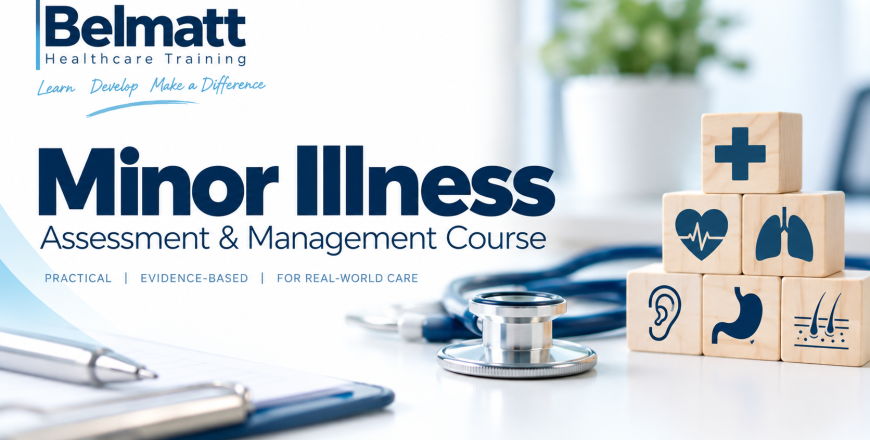
The Belmatt Minor Illness Assessment & Management Course is a comprehensive 3-day hybrid minor illness course designed for healthcare professionals assessing and managing patients with common acute and minor illnesses. Combining one live interactive webinar on Zoom with two face-to-face classroom days in Lowestoft, Suffolk, the programme provides a practical, clinically focused approach to history taking, physical assessment, differential diagnosis, red-flag recognition, clinical management, referral and safety-netting.
The course is suitable for nurses, Advanced Nurse Practitioners (ANPs), Advanced Clinical Practitioners (ACPs), paramedics, pharmacists and other healthcare professionals working in general practice, primary care, urgent care, same-day services and community healthcare.
Teaching is delivered by an experienced multidisciplinary clinical faculty and uses real-world cases to help participants translate evidence and guidelines into everyday clinical practice.
Course Dates & Delivery
Wednesday 2 December 2026 – Live Interactive Webinar via Zoom : Join the faculty online for a full day of live, interactive case-based teaching, discussion and Q&A.
Monday 7 December 2026 – Classroom Training, Lowestoft : Face-to-face teaching with opportunities to develop structured approaches to clinical assessment, examination and decision-making.
Tuesday 8 December 2026 – Classroom Training, Lowestoft : A further day of practical, case-based learning focused on assessment, differential diagnosis, management, escalation and safety-netting.
What Will You Learn?
By the end of the programme, participants will be better equipped to:
- undertake structured minor illness consultations and clinical assessments;
- formulate appropriate differential diagnoses;
- recognise important clinical red flags and signs of deterioration;
- distinguish common minor illness from potentially serious disease;
- make evidence-informed management decisions;
- identify when further investigation is required;
- determine when a patient requires referral or urgent escalation;
- manage diagnostic uncertainty safely;
- provide effective safety-netting and follow-up advice; and
- document clinical reasoning and management decisions appropriately.
ENT & Eye Presentations Jeshni Amblum-Almer – Advanced Nurse Practitioner & Independent Prescriber
Develop a systematic approach to assessing common ear, nose, throat and eye presentations encountered in primary and urgent care.
Clinical cases will explore assessment, differential diagnosis, red flags, initial management, safety-netting and indications for referral or escalation.
Respiratory Illness & Acute Respiratory Presentations
- Respiratory symptoms are among the most frequent presentations encountered in primary care.
- Through clinical scenarios, participants will explore how to distinguish common self-limiting respiratory illness from presentations requiring further assessment, including pneumonia, asthma and COPD exacerbations and potentially serious respiratory disease.
- The session will also consider antimicrobial decision-making, clinical deterioration and appropriate escalation.
Abdominal Pain & Gastrointestinal Presentations
Abdominal pain can represent anything from a minor, self-limiting condition to a potentially life-threatening medical or surgical emergency.
Participants will develop a structured approach to:
- history and assessment;
- differential diagnosis;
- identification of red flags;
- investigation and management decisions; and
- referral and escalation.
A central question throughout the session is: Can this patient be safely managed in primary care, or do they require urgent assessment?
Headache & Back Pain
- Headache and back pain are common presentations in general practice and urgent care, but occasionally indicate serious underlying pathology.
- Case-based teaching will help clinicians identify red flags and important diagnoses that must not be missed, while developing appropriate management and safety-netting strategies for uncomplicated presentations.
Dermatology
Develop confidence in assessing common skin presentations in primary care using clinical cases and images.
The session will focus on:
- dermatological pattern recognition;
- developing differential diagnoses;
- treatment and management decisions;
- recognising dermatological red flags; and
- knowing when to refer or escalate.
Women’s Health in Primary Care : Emergency Contraception | Abnormal Uterine Bleeding | Menopause & Perimenopause
- This focused women’s health update explores common presentations encountered in general practice, urgent care and same-day services.
- Topics include emergency contraception, with assessment, contraceptive options, clinical considerations, counselling and follow-up.
- Participants will also develop a structured approach to abnormal uterine bleeding, including differential diagnosis, investigation and recognition of important red flags.
- Menopause and perimenopause teaching will explore assessment, evidence-based management and recognition of presentations requiring further investigation or referral.
Infection, Fever & Antimicrobial Prescribing
Assessment of infection and appropriate antimicrobial prescribing are integrated throughout the programme rather than considered in isolation.
Teaching will explore:
- differentiating likely viral and bacterial infections;
- assessment of fever;
- recognising the deteriorating patient;
- antimicrobial stewardship;
- appropriate antibiotic prescribing;
- antibiotic adverse effects and interactions;
- renal function and antimicrobial choice;
- considerations in older and frail patients; and
- clinical review and safety-netting.
Clinical Reasoning & Consultation Skills
Safe minor illness practice involves more than memorising individual conditions. Clinicians need to recognise patterns, develop differentials, identify uncertainty and decide when a patient no longer fits a typical minor illness pathway.
The programme therefore places clinical reasoning and decision-making at the centre of learning.
Teaching methods include face-to-face classroom teaching, live interactive Zoom teaching, real-world clinical cases, differential diagnosis exercises, clinical scenarios, assessment and examination demonstrations, practical consultation approaches, faculty Q&A, peer discussion and evidence-based clinical teaching.
6 Months’ Access to Minor Illness eLearning
Your learning continues after the three taught days.
Participants receive six months’ access to the Belmatt Learning Management System (LMS), providing course resources, session recordings where available and additional eLearning.
Additional learning includes:
- Chest Pain Assessment
- Mental Health Conditions
- Antimicrobial Prescribing & Stewardship
- Vitamin B12 Deficiency
These resources provide an opportunity to consolidate and extend learning following the taught sessions and contribute to the programme’s 30 hours of participatory CPD.
Who Should Attend?
This hybrid Minor Illness Assessment & Management Course is suitable for healthcare professionals who assess patients presenting with acute and minor illness, including Advanced Nurse Practitioners (ANPs), Advanced Clinical Practitioners (ACPs), Nurse Practitioners, Practice Nurses, Primary Care Nurses, paramedics, pharmacists, clinicians moving into general practice or urgent care, and healthcare professionals developing advanced clinical assessment and decision-making skills.
It may also be particularly useful for clinicians preparing to undertake further advanced practice education, including independent prescribing, who want to strengthen their assessment, differential diagnosis and clinical reasoning skills.
Why Choose the Belmatt Minor Illness Course?
The hybrid format combines the accessibility of live online learning with the benefits of two days of face-to-face classroom teaching in Lowestoft.
Rather than focusing solely on individual diagnoses, the course develops a transferable approach to the minor illness consultation: assess the patient, develop a differential diagnosis, identify red flags, make a safe management decision and provide appropriate safety-netting.



Social Network