
Anaphylaxis Update 2026

- Description
- Curriculum
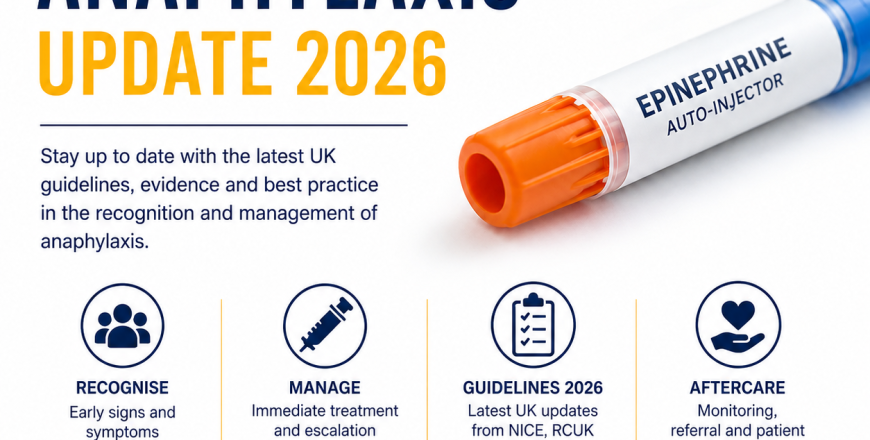
Anaphylaxis is a medical emergency requiring rapid recognition, prompt treatment and safe follow-up. This Anaphylaxis Update 2026 course is designed for healthcare professionals who need to refresh their knowledge, meet CPD requirements and maintain confidence in managing anaphylaxis in clinical practice.
The course is aligned with current UK guidance, including Resuscitation Council UK, NICE NG258, MHRA safety advice on adrenaline auto-injectors, and BSACI guidance for primary care. NICE published NG258 in May 2026, replacing the previous anaphylaxis assessment and referral guidance.
This practical update covers the recognition, emergency management and follow-up of anaphylaxis in adults and children. It is suitable for staff working in general practice, urgent care, community healthcare, outpatient services, vaccination clinics, schools, care settings and independent healthcare.
Participants will review the latest recommendations on adrenaline use, patient positioning, adrenaline auto-injectors, calling 999, documentation, referral to allergy services, and risk reduction after an anaphylactic reaction.
This course is suitable for:
Nurses, GPs, pharmacists, paramedics, physician associates, healthcare assistants, advanced practitioners, practice nurses, school nurses, vaccination teams, urgent care clinicians, dental teams and other healthcare professionals who may need to recognise or respond to anaphylaxis.
Key Topics Covered
Recognition of Anaphylaxis
Understand the key signs and symptoms, including airway, breathing, circulation and skin changes.
Immediate Emergency Management
Review the ABCDE approach, emergency escalation, oxygen, monitoring and when to call 999.
Adrenaline as First-Line Treatment
Adrenaline remains the first-line treatment for anaphylaxis. Resuscitation Council UK states that the recommended adult and teenager dose is 500 micrograms IM adrenaline, while many adult auto-injectors deliver 300 micrograms.
Adrenaline Auto-Injectors
Review current safety advice, correct use, patient education and why patients at significant risk should usually have two adrenaline auto-injectors available at all times.
Positioning During Anaphylaxis
Understand safe positioning, including avoiding sudden standing or walking during a reaction.
Post-Reaction Care and Referral
Explore observation, discharge advice, documentation and referral to specialist allergy services in line with NICE NG258.
Why Choose This Course?
This course provides a concise, clinically focused update for healthcare professionals who need practical, up-to-date anaphylaxis training. It supports safer practice, improves confidence in emergency response and helps organisations evidence staff CPD and mandatory training compliance.
Course Type: eLearning
CPD Hours: 1hr
Suitable For: Healthcare professionals
Certificate: Certificate of completion provided






Social Network