
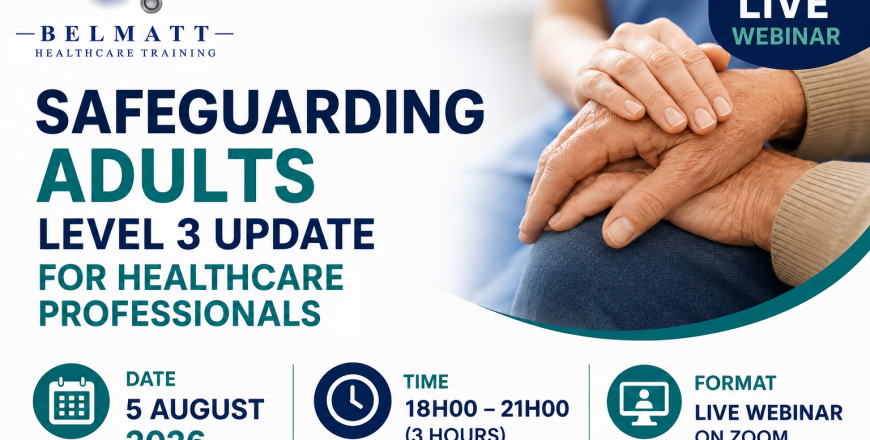
Safeguarding Adults Level 3 Webinar 5 August 2026

- Description
- Curriculum
- Notice
Date: 5 August 2026
Time: 18:00–21:00 UK time
Format: Live interactive webinar via Zoom
CPD: 3 participatory hours
Develop Confidence in Recognising and Responding to Adult Safeguarding Concerns
This interactive Safeguarding Adults Level 3 course is designed for healthcare professionals who assess, plan, deliver or evaluate care for adults. The webinar provides a practical update on recognising abuse and neglect, responding to safeguarding concerns and fulfilling your professional responsibilities. It will help you make proportionate, person-centred decisions while working within relevant legislation, national guidance, local safeguarding procedures and your professional code. Through realistic case studies and facilitated discussion, you will explore safeguarding challenges commonly encountered in primary care, urgent care, community services, care homes, mental health services and acute healthcare settings.
This webinar will help you develop a structured approach to:
- Recognising possible abuse, neglect and exploitation
- Speaking with adults sensitively and respectfully
- Applying professional curiosity
- Assessing immediate risk
- Considering mental capacity and consent
- Sharing information appropriately
- Recording concerns clearly
- Escalating or referring concerns through the correct pathway
- Working effectively with safeguarding leads and partner agencies
- Supporting person-centred safeguarding decisions
The emphasis throughout the session is on safe, proportionate and professionally accountable practice.
Who Should Attend?
This Level 3 safeguarding adults webinar is suitable for healthcare professionals whose roles involve assessing, planning, delivering or evaluating care for adults, including:
- Nurses and nursing associates
- Advanced Clinical Practitioners
- Advanced Nurse Practitioners
- General Practitioners
- Pharmacists
- Paramedics
- Physician Associates
- Allied Health Professionals
- Healthcare support workers and Healthcare Assistants whose roles require Level 3 competencies
- Care home clinicians
- Mental health practitioners
- Community healthcare professionals
- Primary care and urgent care staff
- Outpatient and acute care professionals
- Healthcare professionals requiring a Safeguarding Adults Level 3 update
Participants should follow their employer’s training-needs analysis and local safeguarding policy when determining the level of training required for their role.
What Will the Course Cover?
Safeguarding Law, Guidance and Professional Responsibilities
Develop an understanding of the legal and professional frameworks that support adult safeguarding practice.
Topics include:
- Relevant UK safeguarding frameworks
- The Care Act 2014 and statutory safeguarding duties in England
- The six principles of adult safeguarding
- Professional accountability and duty of care
- Organisational safeguarding responsibilities
- Local safeguarding policies and referral pathways
- The role of Safeguarding Adults Boards
- Learning from Safeguarding Adults Reviews
Because safeguarding legislation and procedures differ across England, Scotland, Wales and Northern Ireland, delegates must also follow the legislation and local arrangements that apply in their country of practice.
Recognising Abuse and Neglect
Explore the different forms of abuse and the indicators that may suggest an adult is at risk.
The session considers:
- Physical abuse
- Sexual abuse
- Psychological and emotional abuse
- Financial or material abuse
- Domestic abuse
- Discriminatory abuse
- Organisational abuse
- Neglect and acts of omission
- Self-neglect
- Modern slavery
- Criminal and sexual exploitation
Delegates will consider how abuse may occur within families, intimate relationships, care environments, communities and professional settings.
Safeguarding Red Flags
Learn how to identify signs that should prompt further assessment or escalation, including:
- Unexplained or repeated injuries
- Delays in seeking healthcare
- Fearful, withdrawn or distressed behaviour
- A controlling family member, partner or carer
- Restricted access to money, medication or communication
- Poor hygiene, malnutrition or unsafe living conditions
- Repeated missed appointments
- Inconsistent or changing accounts
- Medication mismanagement
- Signs of coercion, exploitation or neglect
- Concerns about the quality or safety of care
The course will emphasise that individual indicators do not always prove abuse but may require sensitive enquiry, risk assessment and professional curiosity.
Domestic Abuse and Coercive Control
Explore how domestic abuse may affect adults of different ages, genders, backgrounds and circumstances.
Topics include:
- Recognising controlling and coercive behaviour
- Asking about domestic abuse safely
- Responding to a disclosure
- Considering immediate danger
- Supporting adults with additional vulnerabilities
- Recording concerns appropriately
- Referral and escalation options
- Multi-agency risk management
Self-Neglect and Hoarding
Develop a balanced approach to safeguarding situations involving self-neglect or hoarding.
The session examines:
- Indicators of self-neglect
- Environmental and fire risks
- Nutrition, hygiene and medication concerns
- The relationship between autonomy, capacity and risk
- Executive capacity and the ability to carry out decisions
- Professional disagreement and escalation
- Multi-agency responses
- Person-centred risk management
Modern Slavery and Exploitation
Learn to recognise indicators of:
- Forced labour
- Domestic servitude
- Sexual exploitation
- Criminal exploitation
- Human trafficking
- Financial control
- Restricted movement or communication
- Fear of authorities or accompanying individuals
The session will consider safe enquiry, immediate risk and appropriate referral pathways.
Mental Capacity, Consent and Best-Interest Decisions
Explore the relationship between safeguarding, autonomy and the Mental Capacity Act 2005 in England and Wales.
Topics include:
- Presuming capacity
- Decision-specific and time-specific assessment
- Supporting people to make their own decisions
- Understanding that an unwise decision does not automatically indicate a lack of capacity
- The two-stage capacity assessment
- Best-interest decision-making
- The least restrictive option
- Fluctuating capacity
- Undue influence and coercion
- Documenting capacity-related decisions
Delegates practising outside England and Wales should follow the mental-capacity legislation applicable within their country.
Making Safeguarding Personal
Consider how to place the adult’s views, wishes and desired outcomes at the centre of safeguarding practice.
This includes:
- Listening to the adult
- Establishing what matters to them
- Supporting informed decision-making
- Balancing autonomy with the risk of harm
- Recognising communication needs
- Considering advocacy
- Avoiding unnecessarily paternalistic responses
- Reviewing whether safeguarding actions achieved the person’s desired outcomes
Communication and Professional Curiosity
Strengthen your ability to explore concerns respectfully without making assumptions.
You will consider:
- Creating a safe environment for discussion
- Asking clear, non-leading questions
- Communicating with people who have additional needs
- Using interpreters appropriately
- Recognising disguised compliance
- Respectful challenge
- Avoiding professional optimism
- Exploring inconsistencies
- Escalating unresolved concerns
Information Sharing and Confidentiality
Develop confidence in deciding when safeguarding information should be shared.
Topics include:
- Seeking consent where appropriate
- Considering capacity to consent
- Sharing relevant and proportionate information
- Situations in which information may need to be shared without consent
- Immediate risk and prevention of serious harm
- Public-interest considerations
- Protecting other adults or children
- Recording the reasons for sharing or withholding information
- Following local information-governance procedures
Safeguarding Documentation
Learn how to produce clear, accurate and professionally defensible safeguarding records.
The course will cover:
- Recording facts separately from professional opinion
- Documenting the adult’s own words
- Recording visible injuries or relevant observations
- Avoiding judgmental or ambiguous language
- Documenting capacity and consent
- Recording who was contacted and when
- Recording referrals, advice and escalation
- Documenting the rationale for decisions
- Maintaining an appropriate chronology
- Correcting inaccurate records appropriately
Referral and Escalation
Develop a practical approach to responding when a concern is identified.
This includes:
- Addressing immediate medical and safety needs
- Contacting emergency services when required
- Following local safeguarding referral procedures
- Consulting the organisation’s safeguarding lead
- Escalating when concerns are not addressed
- Managing professional disagreement
- Whistleblowing and speaking up
- Preserving evidence where a crime may have occurred
- Providing appropriate follow-up and safety-netting
Multi-Agency Safeguarding
Explore the contribution of healthcare professionals to coordinated safeguarding responses involving:
- Adult social care
- Primary and secondary healthcare services
- Mental health teams
- Police
- Ambulance services
- Care providers
- Advocacy services
- Domestic abuse services
- Housing organisations
- Safeguarding Adults Boards
- Other relevant statutory and voluntary-sector agencies
Case-Based Learning
Throughout the webinar, participants will apply their knowledge to realistic clinical scenarios involving:
- Suspected neglect
- Domestic abuse
- Self-neglect and hoarding
- Financial exploitation
- Concerns about a carer
- Mental capacity and refusal of support
- Information sharing
- Poor-quality or unsafe care
- Escalation when a safeguarding response is delayed
Teaching and Learning Methods
This is a live, participatory webinar rather than a passive recording.
Teaching methods include:
- Expert-led presentation
- Case-based discussions
- Practical safeguarding scenarios
- Interactive questions
- Reflective exercises
- Application of guidance to clinical practice
- Opportunities to ask questions
Participants must attend and participate in the live session to claim the three participatory CPD hours.
Why Attend This Course?
- Update your knowledge of adult safeguarding practice
- Improve your recognition of abuse, neglect and exploitation
- Strengthen your response to complex safeguarding concerns
- Develop confidence in mental-capacity and consent considerations
- Improve safeguarding documentation
- Understand information-sharing and escalation principles
- Learn through realistic healthcare scenarios
- Support safer, person-centred clinical practice
- Gain three participatory CPD hours
Important Information About Level 3 Competence
This three-hour webinar supports the development and maintenance of relevant Level 3 adult safeguarding knowledge and competencies.
Attendance at a single course does not, by itself, confirm complete occupational competence. Safeguarding competence should also be developed through experience, supervision, reflective practice, familiarity with local procedures and any additional learning required by the participant’s employer or professional role.
Book Your Place
Strengthen your knowledge, improve your safeguarding decision-making and build confidence in responding to adults who may be at risk of abuse or neglect.
Book your place on the Safeguarding Adults Level 3 live webinar.
Lecturer: Fadzai Mashingaidze

Fadzai Mashingaidze is an experienced healthcare educator and safeguarding trainer with a background in nursing, clinical education and workforce development. She has extensive experience delivering safeguarding training to multidisciplinary healthcare teams working across primary care, urgent care, community and care home settings.
Fadzai is passionate about improving safeguarding awareness within healthcare and supporting clinicians to recognise vulnerability, abuse, neglect and risk in both adults and children. Her teaching style combines practical clinical scenarios, reflective discussion and current UK safeguarding guidance to help delegates apply learning confidently within everyday practice.
She regularly delivers safeguarding education, mandatory training and professional development programmes for healthcare professionals and is committed to promoting safe, compassionate and patient-centred care.
Live webinar using zoom. You are required to interact in discussions in the webinar and keep your camera on.







Social Network