
Blog
Vitamin D as a Marker of Metabolic Health: Beyond Bones and Blood Tests
In recent years, and especially since the COVID pandemic, there has been increased public interest in sustainable approaches to health and a greater focus on biomarkers, genetic testing, and functional health strategies. Vitamin D is best known for its role in bone health, but over the last two decades it has attracted growing interest for its potential role in cardiovascular health. I have always been interested in the importance of vitamins in supporting health. Over the next few weeks, I will be exploring several vitamins: where the evidence is strong, where it’s overstated, and where nuance really matters.
What is vitamin D?
Vitamin D is a fat-soluble hormone produced mainly in the skin through sunlight exposure and, to a lesser extent, obtained from diet and supplements. Its chemical structure was identified in 1930 by Nobel Prize laureate Adolf Otto Reinhard Windaus. While initial research focused on its effects on bone health, studies have since expanded to recognise its importance in immune-mediated diseases, infections, cancers, and heart disease.
Vitamin D’s actual role is to act as a hormone that helps the body regulate calcium balance and maintain normal function across multiple systems, rather than simply serving as a vitamin. Its primary and proven role is in bone and muscle health, where it increases calcium and phosphate absorption from the gut, supports bone mineralisation, and prevents conditions such as rickets, osteomalacia, and contributes to fracture prevention in older adults.
The liver plays a central role in how vitamin D works in the body. Its main cells, called hepatocytes, convert vitamin D into the form we measure in blood tests and are also responsible for managing cholesterol, metabolism, and detoxification. When vitamin D levels are low, this balance can be disrupted, contributing to conditions such as fatty liver disease, raised cholesterol, and insulin resistance. Vitamin D also acts on the smooth muscle that lines our blood vessels and airways, helping them relax and contract appropriately. Low vitamin D has been linked with stiffer arteries, higher blood pressure, and increased airway reactivity, which may help explain its association with cardiovascular disease and asthma. The lining of blood vessels called the endothelium, is another important site of action. Adequate vitamin D supports healthy endothelial function, reduces inflammation and oxidative stress, and may help slow the early development of atherosclerosis and microvascular complications, particularly in people with diabetes. Vitamin D has a clear role in immune health. Its receptors are found on many immune cells, where it helps the body fight infection while also preventing excessive or misdirected inflammation. This is why low vitamin D is often seen alongside recurrent infections, autoimmune conditions, and chronic inflammatory states.
Where do we get vitamin D from?
We get most of our vitamin D from sunlight and some from foods such as oily fish, meat, egg yolks, and fortified foods. In cases of vitamin D deficiency, food sources are usually not enough, and supplementation is required for those with limited sun exposure. But sunlight remains the main source, hence that 20-30 minute walk when the sun is shining does you a world of good. There is no single definition of “safe” or “optimal” sun exposure, but in the UK and northern Europe a practical rule of thumb is short, regular exposure during the months when the sun is strong enough to support vitamin D production. For most people, around 10–15 minutes of midday sunlight on most days, exposing areas such as the forearms, lower legs, or face and arms, between April and September is usually sufficient. This brief exposure should be without sunscreen, stopped well before the skin begins to turn red, and followed by sunscreen or covering up if staying outdoors for longer. Midday exposure matters because vitamin D production depends on UVB rays, which are strongest when the sun is highest in the sky, roughly between 11am and 3pm in the UK. Early morning or late-afternoon sunlight may feel warm, but it contains very little UVB and therefore contributes minimally to vitamin D synthesis.
Skin tone also plays an important role. Melanin, the pigment that gives skin its colour, protects against ultraviolet damage by absorbing UV radiation. However, this protective effect also reduces the skin’s ability to produce vitamin D3, as melanin absorbs much of the UVB needed to trigger vitamin D synthesis in the skin. As a result, people with darker skin require longer sun exposure to generate the same amount of vitamin D as those with lighter skin. In temperate climates such as the UK and northern Europe, where sunlight is weaker for much of the year, this places individuals with darker skin at a significantly higher risk of vitamin D deficiency. As a rough guide, people with lighter skin may need around 10–15 minutes of midday sun, those with darker skin around 25–40 minutes or more, and for people with very dark skin, sun exposure alone is often insufficient year-round. For this reason, year-round vitamin D supplementation is commonly recommended for people with darker skin living at northern latitudes.
Sunlight helps — but in the UK, supplements do much of the heavy lifting.
Vitamin D supplementation: practical guidance
In the UK (and internationally), vitamin D3 (cholecalciferol) is the preferred form for supplementation because it:In the UK and internationally, vitamin D3 (cholecalciferol) is the preferred form for supplementation because it is the same form the body produces in response to sunlight, raises blood 25-hydroxyvitamin D levels more effectively than vitamin D2, and provides better long-term maintenance of vitamin D status. For this reason, most clinical guidelines and dietetic sources recommend vitamin D3 unless there is a specific indication to use vitamin D2, such as vegan requirements or specialist advice. For the general population, UK guidance advises considering a daily supplement of 10 micrograms (400 IU) from October to March, as sunlight at northern latitudes is insufficient to support vitamin D production during these months; this baseline dose supports bone health and muscle function and is endorsed by the NHS and Public Health England. Some people are at higher risk of deficiency and may benefit from year-round supplementation, including those with limited sun exposure, people with darker skin, older adults, individuals who cover their skin for cultural or personal reasons, those with conditions affecting absorption, and in some guidance, pregnant and breastfeeding women. Most over-the-counter preparations provide between 400 and 1000 IU daily and are available as tablets, capsules, drops, or sprays, with absorption improved when taken with food as vitamin D is fat-soluble. Over-the-counter preparations usually provide 400–1000 IU daily and are available as tablets, capsules, drops, or sprays. Vitamin D is fat-soluble, so absorption improves when taken with food.
Treating deficiency
When deficiency is confirmed, clinicians may prescribe according to local policy nd guidelines.
- 50,000 IU weekly for 6–7 weeks, or
- 1,000–4,000 IU daily for a defined period
Safety Considerations
Upper limits: Most guidelines and safety reviews note that daily intakes up to about 100 micrograms (4000 IU) are generally considered safe for adults without supervision. Avoid mega-dosing without monitoring: Very high doses (e.g., >5000 IU daily over long periods) can increase the risk of vitamin D toxicity, potentially leading to hypercalcemia, with symptoms such as nausea, weakness, and kidney issues. Clinical monitoring is recommended if higher doses are used.
General advice: These recommendations are intended as general guidance only and should be used with caution in people with kidney or liver disease or other medical conditions, where supplementation should always be discussed with a doctor or qualified healthcare professional. In the UK, adults are advised to take at least 10 micrograms (400 IU) of vitamin D daily from October to March, with year-round supplementation considered for those at higher risk of deficiency. Vitamin D3 (cholecalciferol) is the preferred form for supplementation, and higher therapeutic doses should only be used under clinician supervision with appropriate monitoring.
What about Vitamin D Toxicity
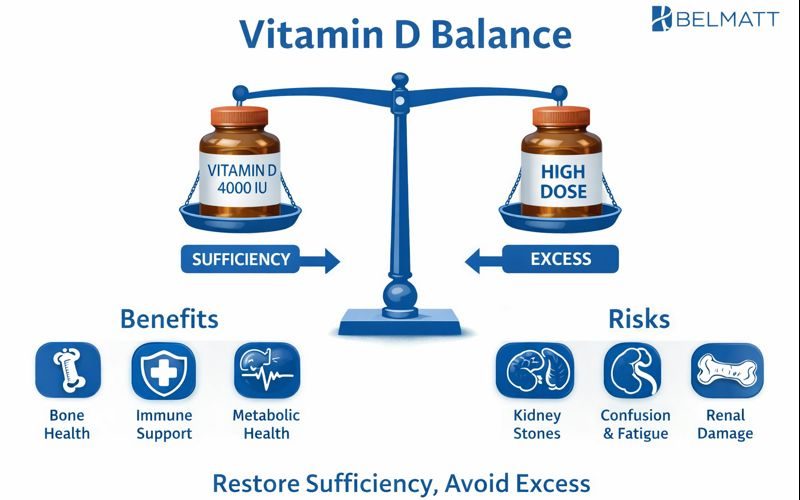
Vitamin D toxicity is uncommon but increasingly relevant in an era of self-directed supplementation and cumulative intake from high-dose products and fortified foods. While vitamin D was long considered almost universally safe, emerging evidence shows that deficiency and excess can coexist within the same populations, particularly among older adults and those taking multiple supplements without monitoring. Most people tolerate moderate increases in vitamin D levels well, but a small proportion cross a physiological threshold where harm occurs, driven not by vitamin D itself but by hypercalcaemia, which can present with vague symptoms such as nausea, constipation, fatigue, and weakness, and in more severe cases lead to kidney stones, renal impairment, ectopic calcification, and neurocognitive changes. Risk appears higher when vitamin D is combined with calcium supplementation, as studies demonstrate hypercalciuria and occasional hypercalcaemia even at modest doses, and long-term trials have raised concerns about reduced bone density with sustained high-dose vitamin D (≥4,000 IU/day) without added benefit. The clinical message is therefore one of balance rather than alarm: vitamin D is essential for musculoskeletal, immune, and metabolic health, but supplementation should aim to correct deficiency and restore sufficiency, not pursue ever-higher targets without clear evidence of benefit.
“Nutrients Rarely Act in Isolation — They Travel with Behaviours”
Vitamin D is one of those nutrients that tells a much bigger story than a single blood result. Because most of our vitamin D comes from sunlight, levels are closely tied to how we live day to day. Time spent outdoors, physical activity, diet quality, body weight, smoking, alcohol intake, and even where and how we live all influence vitamin D status. People who are more active and spend time outside tend to have higher vitamin D levels and better overall cardiometabolic health. In contrast, those who are more sedentary, live mostly indoors, eat more processed foods, or carry excess body weight often have lower vitamin D levels, not because vitamin D is the problem, but because it reflects a wider pattern of lifestyle and metabolic stress. This is why low vitamin D is linked to so many different conditions: heart disease, diabetes, infections, frailty, and low mood. Vitamin D is fat-soluble and becomes “hidden” in body fat, so people with higher BMI often show lower blood levels. Smoking, excess alcohol, chronic stress, and socioeconomic disadvantage further compound this by affecting diet, sun exposure, and inflammation.
The Vitamin D and Cholesterol Connection: What the Evidence Shows
Low vitamin D levels are commonly seen in people with obesity, physical inactivity, insulin resistance, chronic low-grade inflammation, and poorer metabolic health. These same factors independently drive higher LDL cholesterol and cardiovascular risk. Vitamin D receptors are present in liver cells, blood vessels, and immune cells, and vitamin D appears to support metabolic balance, immune regulation, and inflammatory control. It may modestly influence how LDL behaves in the body, for example, by supporting LDL clearance or reducing inflammatory modification, but it does not directly lower LDL in a clinically meaningful way.
This helps explain why low vitamin D is linked not only to adverse lipid profiles, but also to:
- Impaired immunity
- Poorer blood sugar control
- Higher cardiometabolic risk
Vitamin D deficiency is associated with insulin resistance, increased susceptibility to infections, and chronic inflammation, all of which cluster with raised LDL cholesterol.
Association is not causation
Large observational studies consistently show that people with lower vitamin D levels tend to have:
- Higher total cholesterol
- Higher LDL cholesterol
- Higher triglycerides
- Often lower HDL cholesterol
These associations are strongest in people with obesity, type 2 diabetes, metabolic syndrome, and limited sun exposure. But association does not equal causation.
Vitamin D is deeply tied to how we live. Time outdoors, physical activity, diet quality, body weight, smoking, alcohol intake, and socioeconomic circumstances all shape vitamin D status. Low levels often reflect a broader pattern of lifestyle and metabolic stress, rather than a single nutrient problem.
What does this mean for clinical practice?
The message is balanced and reassuring:
- Check vitamin D where clinically appropriate
- Correct deficiency for bone, muscle, immune, and general health
- Do not delay or replace evidence-based lipid management
- Take supplement with a meal that contains some fat as it improves absorption. Take in morning or midday.
- Magnesium activates vitamin D and converts it into a useable form and should be considered if low response to vitamin D, diet low in nuts, seeds and legumes or there is muscle cramps and fatigue also preset.
- There is some evidence for Vitamin K2 as it helps direct calcium into bones rather than blood vessels and you should discuss this with your GP if taking higher doses of vitamin D long term, osteoporosis.
For cholesterol reduction, the evidence remains unequivocal: Lifestyle optimisation and lipid-lowering medications save lives.
In populations where vitamin D deficiency is relatively uncommon, routine screening of the general population is not cost-effective. Instead, decisions to test should be guided by a risk-based approach, focusing on individuals more likely to be deficient. Targeted screening of high-risk groups is more appropriate and may be clinically beneficial, given the well-established adverse effects of vitamin D deficiency on skeletal and overall health. This is particularly important when serum 25-hydroxyvitamin D concentrations fall below 30 nmol/L (12 ng/mL), a level associated with a significantly increased risk of clinical consequences.
Vitamin D sits at a fascinating intersection of lifestyle, metabolism, and cardiovascular risk. Its relationship with cholesterol reminds us of an important truth in medicine: Not everything associated with disease is a cause, but associations still tell a story worth listening to. Understanding that story allows us to practise medicine that is scientifically rigorous and humanly sensible.
Good medicine doesn’t chase shortcuts — it respects evidence, context, and the long game.